MicroMachines
From Scientific American On-Line
http://www.sciam.com/article.cfm?articleID=000DA6AE-1F32-1CDF-B4A8809EC588EEDF&sc=I100322

MICROMACHINES like the ones envisioned here could someday serve as tiny mechanical doctors. These miniature devices would roam between the red cells of the bloodstream, seeking out and destroying harmful viruses (shown here as green geometric solids). The moving parts of the micromachines would be built around gears no bigger than a protein molecule.

For now, such microscopic robots exist only in the imaginations of nanotechnologists and the artists who depict their ideas. But some technological visionaries, led by K. Eric Drexler, think that the vision
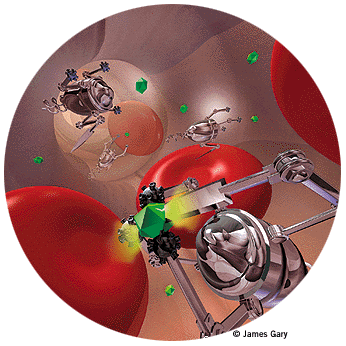

will soon become reality and will transform everything from health care to food production. Scientists have recently demonstrated the ability to manipulate individual atoms and build simple structures; this work may represent the first, tentative step in establishing the viability of nanotechnology.

Nanotechnology is the blanket term used to describe the precision manufacture of materials and structures of molecular dimensions. Many of the goals of nanotechnology were expressed nearly 40 years ago by the renowned physicist Richard P. Feynman. Molecular-scale robots currently exist only in the imaginations of nanotechnologists and the artists who depict their ideas. But some technological visionaries, led by K. Eric Drexler, think that the dream will soon become a reality that will transform everything from health care to food production. (Drexler's ideas are outlined in his book Engines of Creation).

Engineers have developed tiny gears and motors that hint at the promise of making such molecular devices; researchers at Sandia National Laboratories in Albuquerque, New Mexico recently announced the creation of "intelligent" micromachines that incorporate integrated-circuit controllers.

New tools like scanning tunneling microscopes permit the manipulation of individual atoms. Drexler and other nanovisionaries believe that this invention marks a step toward the manufacture of molecular gears and other components needed for constructing nanometer-scale (billionth of a meter) machines.

Despite such advances, many researchers consider Drexler's goals for molecular nanotechnology to be a pie-in-the-sky fantasy, as described in a recent Scientific American article (see "Waiting for Breakthroughs," by Gary Stix; Scientific American, April 1996). That article has prompted a vehement rebuttal from the Foresight Institute, written by Ralph C. Merkle of Xerox PARC in Palo Alto, Calif.

MORE LINKS TO RELATED MATERIAL:
All are bad links in need of repair!!

Nanotechnology resources from NASA
www.nas.nasa.gov/NAS/Education/nanotech/nanotech.html


IBM image gallery of atomic manipulations
www-i.almaden.ibm.com/vis/stm/gallery.html

Simulations of fullerene-based nanogears
chem.iupui.edu/Research/Robertson/Robertson.html#Gears

Visualizing molecules
scsg9.unige.ch/eng/toc.html